From Tag Sprawl to Trust by Default: A 2026 Cloud Security Operating Model for Identity, Zero Trust, and DevSecOps
Editorial workflow used for this article: Lead Editor brief → Reporter field notes (Reddit + official references) → Writer draft → Copydesk technical and language pass → Final Editor publication sign-off.
Lead Editor Brief: Why This Topic, Why Now
Cloud security conversations in early 2026 are converging on one uncomfortable truth: most organizations are not failing because they lack tools, but because they lack operating discipline across identity, ownership, and secure defaults. The average enterprise now runs workloads across multiple cloud accounts, several identity providers, dozens of repositories, and a sprawling matrix of managed services. Despite all of this sophistication, incidents still begin with ordinary mistakes: over-permissioned access, inconsistent tagging and ownership, weak token governance, brittle CI/CD controls, and delayed detection of policy drift.
At the same time, leaders are being asked to do two things that can feel contradictory: move faster and reduce risk. Security teams are expected to support AI-heavy product cycles, global engineering teams, and near-constant release cadences, all while proving measurable improvements in resilience, compliance, and incident readiness. This pressure is why practical cloud security discussions are shifting away from abstract architecture diagrams and toward operating models that can be implemented by platform teams this quarter, not three years from now.
The most useful public discussions right now reflect this practical shift. A recent Reddit thread in r/aws discussing real-world tagging governance highlighted a familiar journey: teams do not struggle to understand that tagging matters; they struggle to make tagging useful, enforceable, and tied to accountability. That is not just a FinOps issue. In cloud security terms, tags become policy handles: they link resources to owners, environments, incident response pathways, data handling requirements, and access boundaries. If those handles are inconsistent, security controls become inconsistent too.
To ground this article in durable guidance, we pair community signals with two official sources that continue to define the strategic center of gravity for defenders: NIST SP 800-207 (Zero Trust Architecture) and CISA’s Secure by Design principles. Together, these references reinforce a consistent message. First, trust cannot be inherited from network position; it must be continuously evaluated based on identity, device, context, and policy. Second, security cannot be bolted on as a premium feature; it must be a default quality of the product and platform itself.
This article proposes a complete, implementation-ready operating model for cloud security teams that need to mature quickly in 2026. It integrates identity security, zero trust enforcement, governance metadata, software supply chain controls, runtime detection, and incident learning loops. It is intentionally opinionated, because many organizations are losing time debating definitions while adversaries exploit operational gaps. If your cloud security program needs a practical blueprint to reduce identity-driven risk without slowing delivery, this guide is designed for you.
Reporter Notes: What the Field Is Saying (Community + Official Guidance)
Community signal (Reddit): In a current r/aws discussion on tagging strategy, practitioners describe a transition from broad “tag everything” intent to a smaller, mandatory tag schema enforced at creation time. The critical insight was not technical novelty; it was governance clarity. Requiring a minimal, high-value set of tags (for example environment, service, and team) increased adoption and enabled reporting and control decisions that map to business reality rather than infrastructure trivia. The thread also surfaced the familiar unresolved challenge of shared infrastructure ownership and cost/control attribution.
Official source 1 (NIST SP 800-207): Zero Trust Architecture formalizes the principle that no implicit trust should be granted based solely on network location or asset ownership. Authentication and authorization must be discrete, policy-driven functions evaluated before access is established, and reassessed as context changes. For cloud operators, this model shifts the security center from perimeter devices to policy decision and enforcement points tied to identity and resource sensitivity.
Official source 2 (CISA Secure by Design): CISA emphasizes executive accountability and secure defaults. Security controls such as MFA, logging, and strong identity integration should be baseline capabilities, not expensive add-ons. The burden of safety should move from customers and small defenders to technology producers and platform builders. In practical cloud terms, this means reducing exploitable conditions by default during design and delivery, not after incidents.
These signals align: organizations need a model where identity is the primary control plane, metadata is reliable enough to drive policy, and secure defaults are consistently enforced in CI/CD and runtime environments. The rest of this article translates those principles into concrete architecture, process, and measurement guidance.
Writer Draft: The Cloud Security Operating Model
1) Design Principle: Identity Is the New Runtime Perimeter
In legacy environments, defenders relied heavily on segmentation and boundary controls. In modern cloud estates, workloads are ephemeral, developers are distributed, APIs are first-class, and machine identities often outnumber humans by orders of magnitude. The perimeter did not disappear; it fragmented into every request path. This is why identity must be treated as a continuously verified runtime control, not just a login event.
Adopting this principle starts with a simple reframing: every cloud action is an identity event. A deployment pipeline pushing an image to production, a serverless function reading a secret, a support engineer initiating elevated access, and a third-party integration requesting tokens are all identity-mediated operations. Therefore, security posture is determined less by whether the network is private and more by whether identity context is rich, validated, and constrained.
Operationally, this means replacing static trust assumptions with dynamic, policy-based access decisions. Roles and service accounts should be narrowly scoped, short-lived credentials should be preferred over long-lived secrets, and high-risk actions should require additional context or approvals. Strongly binding identities to ownership metadata and approved workflows enables defenders to detect abnormal behavior quickly and block risky actions before blast radius expands.
2) Metadata Governance: Why Tags Are Security Controls, Not Admin Decoration
The Reddit discussion on tagging is a mirror of a broader pattern in cloud programs. Teams begin with a sprawling taxonomy that looks complete on paper but collapses under operational friction. Compliance declines, naming conventions drift, and downstream reporting becomes unreliable. Security then inherits noisy inputs, making policy exceptions, risk scoring, and incident routing inconsistent.
A better approach is to define a minimal mandatory tag baseline with security value and enforce it at provisioning time. A practical starting set for most organizations is:
owner_team: accountable team for operational and security response
service_name: business-facing service or capability, not cloud product label
criticality: low, medium, high based on business impact
Not every organization will adopt the exact same keys, but the pattern matters: use tags that support decision-making in access control, incident triage, backup strategy, and change governance. Enforce these keys in Infrastructure as Code checks, admission policies, and organization-level guardrails so resource creation fails fast when required metadata is missing or invalid.
Most importantly, maintain a controlled vocabulary. If one team uses “prod,” another uses “production,” and a third uses “live,” policy coverage silently degrades. Establish centrally versioned schema definitions, publish them as reusable policy modules, and integrate them into developer tooling where errors appear before merge. Teams accept governance when it is predictable, automated, and documented with clear business rationale.
3) Zero Trust in Practice: Policy Decision and Enforcement at Cloud Scale
NIST SP 800-207 gives the conceptual framework; cloud operators must translate it into engineering decisions. In practice, zero trust adoption should prioritize high-risk pathways first: privileged access, production deployments, secrets access, and east-west service communication involving sensitive data.
A reference implementation usually includes:
A Policy Decision Point (PDP) that evaluates identity, device/workload posture, requested action, resource sensitivity, and contextual signals.
One or more Policy Enforcement Points (PEPs) embedded in gateways, workload agents, CI/CD controls, and cloud-native permission systems.
A telemetry pipeline that captures access decisions, denials, policy overrides, and anomalous behavior for continuous tuning.
For human access, centralize authentication with phishing-resistant MFA and conditional access. For machine access, issue short-lived credentials through federation and workload identity mechanisms rather than static keys in environment variables. For service-to-service paths, enforce explicit authorization policies and mutual authentication where feasible. Use risk-based step-up controls for unusual context (new geolocation, atypical time windows, or rare privilege combinations).
Zero trust is often misunderstood as a product purchase. It is better understood as a systems property achieved through consistent policy orchestration. Organizations that succeed do not “finish” zero trust; they build feedback loops that continuously reduce implicit trust assumptions over time.
4) Secure by Design Meets Platform Engineering
CISA’s Secure by Design guidance is especially relevant for cloud platform teams because it reframes accountability. If insecure defaults remain easy and secure paths remain difficult, policy non-compliance should be treated as a platform design failure, not merely a user behavior problem.
Applying secure-by-design principles in cloud delivery means:
Defaulting new services to private networking and explicit ingress rules.
Enabling audit logging and centralized log export by default.
Requiring MFA and SSO integration for all administrative portals.
Provisioning baseline encryption at rest and in transit without opt-in friction.
Shipping hardened reference modules and templates that teams can consume quickly.
Platform teams should publish “golden paths” with built-in controls and transparent guardrails. The more production teams can inherit secure defaults through reusable modules, the less time security spends on one-off reviews. Secure by design is not anti-developer; done well, it removes ambiguity and accelerates safe delivery.
5) Identity Threat Scenarios You Must Assume in 2026
Cloud defenders should plan from adversary behavior, not only compliance frameworks. Identity-centric attacks remain the highest-probability path to material incidents because they exploit trust relationships that legitimate operations already depend on. Key scenarios include:
Token theft and replay: Session tokens or API tokens are exfiltrated from compromised endpoints, build logs, browser artifacts, or misconfigured storage.
Privilege escalation via role chaining: Attackers exploit broad assume-role permissions to traverse accounts and reach high-impact capabilities.
CI/CD compromise: Build agents, dependency pipelines, or signing steps are manipulated to inject malicious artifacts.
Secrets sprawl exploitation: Static keys embedded in repositories, container images, or IaC state files provide durable access.
Control-plane abuse: Adversaries use legitimate APIs to disable logging, alter policies, or create persistence identities.
Your architecture should be tested against these scenarios with explicit detection and containment plans. If a token is stolen, how quickly can you detect anomalous use, revoke trust, rotate credentials, and identify impacted resources? If a pipeline is compromised, can you prove artifact integrity and halt promotion safely? If permissions drift, can you automatically quarantine affected identities?
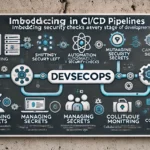
6) DevSecOps Guardrails: Shift Left, Verify Right
Security in delivery pipelines should avoid two failure modes: heavy upfront gates that developers bypass, and lightweight checks that create a false sense of safety. A resilient approach combines early prevention with strong post-deployment verification.
Shift-left controls should include policy-as-code for infrastructure, IaC misconfiguration scanning, secret detection, dependency and container vulnerability checks, and mandatory provenance metadata in build outputs. These controls work best when integrated into pull request workflows with actionable remediation guidance.
Verify-right controls must assume something will pass that should not. Use runtime configuration monitoring, behavior baselining, managed detection rules for control-plane events, and continuous access reviews. Correlate deployment events with subsequent permission changes, network anomalies, and data access patterns. Rapidly identify when expected behavior diverges from declared intent.
One useful governance pattern is “policy contracts”: each service declares expected privileges, data classifications, network peers, and deployment behaviors in machine-readable form. Pipelines validate contracts before release; runtime systems monitor for contract violations after release. This creates continuity between design-time assumptions and production reality.
7) Shared Responsibility, Rebalanced Internally
Cloud providers and customers share security responsibility, but many incidents arise from unclear responsibility within the customer organization itself. Platform teams, application teams, security engineering, SRE, and compliance all control different parts of the risk surface. Without explicit internal contracts, gaps emerge at boundaries.
Service accountability: least privilege for application identities, data handling correctness, service-level logging and alert response.
Security accountability: control design, threat modeling support, detection engineering, incident readiness, and assurance reporting.
Every critical control should have a named owner, measurable service level objective, and escalation path. During incidents, ambiguity is a multiplier of damage. Mature organizations run responsibility mapping exercises and game days to validate that operational handoffs work under pressure.
8) The Role of FinOps Signals in Security Outcomes
The Reddit discussion framed tagging primarily through cost visibility, but FinOps signals can materially improve security operations. Sudden cost anomalies may indicate abuse (cryptomining, unauthorized data movement), provisioning mistakes with exposure implications, or uncontrolled replication of high-privilege resources. Conversely, robust ownership and service tags improve both financial governance and security investigation speed.
Security and FinOps teams should share key telemetry: unusual spend spikes by service, regional anomalies, unexpected data transfer growth, and unplanned high-availability resource proliferation. Combined with identity and change data, these signals often surface early indicators of compromise or major misconfiguration before customer impact escalates.
Where shared infrastructure complicates attribution, create allocation models that are “accurate enough” for decision support, then iterate. Precision should improve over time, but waiting for perfect attribution usually delays useful control action. Governance maturity is cumulative; start with enforceable basics and expand gradually.
9) Metrics That Actually Predict Risk Reduction
Many cloud security dashboards track activity rather than risk. Counting alerts, tickets, or scan volume does not prove improved resilience. Leadership needs metrics tied to exposure, exploitability, and response effectiveness. A practical scorecard can include:
Percentage of human and machine identities using short-lived credentials.
Percentage of production resources meeting mandatory metadata schema.
Median and p95 time to revoke or rotate compromised credentials.
Privilege reduction trend (granted vs used permissions over time).
Coverage of critical workloads by runtime anomaly detection and immutable logging.
Pipeline integrity coverage: signed artifacts, provenance completeness, policy pass rates.
Mean time to detect and contain control-plane abuse events.
Metrics should be paired with explicit target bands and owners. For example, “95% of production service identities must use federated short-lived credentials by Q3,” or “p95 credential revocation under 15 minutes by end of quarter.” Measurable targets drive architectural and process investments that otherwise remain abstract.
10) Implementation Roadmap: 0–30, 31–90, and 91–180 Days
Days 0–30: Establish control foundations
Inventory all human and machine identities with privilege mapping across cloud accounts.
Define and publish mandatory metadata schema and controlled vocabulary.
Enforce schema checks in IaC pipelines for new resources.
Mandate phishing-resistant MFA and disable legacy authentication paths.
Enable centralized immutable logging for control-plane events.
Days 31–90: Reduce implicit trust and tighten pipelines
Move priority machine identities to workload federation and short-lived credentials.
Implement policy decision/enforcement flow for privileged and production actions.
Deploy policy-as-code and secret scanning gates in all production-bound repositories.
Introduce artifact signing and provenance requirements for deployable outputs.
Run first identity attack simulation (token theft and role escalation scenarios).
Days 91–180: Operationalize feedback and assurance
Launch continuous entitlement right-sizing based on observed permission usage.
Integrate FinOps anomaly feeds into security triage workflows.
Implement contract-based runtime drift detection for critical services.
Run cross-functional incident exercises with platform, app, security, and compliance teams.
Publish quarterly risk-reduction scorecard to engineering and executive stakeholders.
This timeline is aggressive but realistic for organizations with executive sponsorship and platform ownership clarity. The objective is not perfection; it is compounding risk reduction.
11) Common Failure Patterns and How to Avoid Them
Failure pattern 1: Treating zero trust as a network project. If identity context, policy orchestration, and workload access controls are not central, “zero trust” becomes branding without effect. Fix: anchor the program around identity lifecycle and authorization enforcement.
Failure pattern 2: Expanding policy scope faster than governance quality. Overly complex taxonomies and exception-heavy policy sets degrade compliance. Fix: start with minimal mandatory controls and expand based on measurable success.
Failure pattern 3: Assuming CI checks equal runtime safety. Build-time validation is necessary but incomplete. Fix: pair pre-merge controls with runtime verification, drift detection, and rapid rollback paths.
Failure pattern 4: Metrics without decisions. Dashboards that do not trigger ownership actions become vanity reporting. Fix: tie every metric to a control owner, target threshold, and escalation policy.
Failure pattern 5: Security as centralized gatekeeper. A single team cannot review every change in high-velocity environments. Fix: distribute control implementation through platform modules and policy automation while keeping central security accountable for standards and detection quality.
12) Executive Guidance: Funding and Governance That Matter
Executives should view cloud security maturity as an operational capability investment, not a compliance tax. The highest return initiatives in 2026 are those that reduce repetitive human decision points and replace them with secure defaults, policy automation, and continuous assurance.
Budget priorities should typically include identity modernization (including machine identity), policy engineering capacity, telemetry and detection quality, and platform enablement for secure-by-default templates. Governance forums should review a concise set of risk indicators monthly, including credential hygiene, privilege drift, control-plane anomaly response, and pipeline integrity coverage.
Board-level communication improves when framed around resilience outcomes: reduced likelihood of identity-led breach, faster containment times, stronger evidence for customer assurance, and lower operational drag on engineering teams. Security programs earn sustained support when they demonstrably improve delivery reliability and business continuity.
13) Practical Reference Architecture (Narrative)
A practical 2026 architecture starts with federated identity at the center. Human users authenticate through a central identity provider with strong MFA, device context checks, and conditional access policies. Machine identities use workload federation to obtain short-lived credentials bound to service context and environment constraints. A policy engine evaluates access requests based on identity, resource classification, approved workflows, and real-time risk signals.
Infrastructure provisioning flows through approved IaC pipelines where policy-as-code validates tagging schema, networking posture, encryption requirements, and forbidden configurations. Build systems generate signed artifacts with provenance metadata, and deployment controllers enforce signature validation before promotion. Runtime environments stream audit and behavior telemetry into a centralized detection layer capable of correlating identity activity, control-plane changes, and anomalous resource usage.
Incident response automation supports immediate high-confidence actions such as revoking sessions, disabling affected identities, isolating workloads, and freezing risky deployment paths. Post-incident reviews feed policy updates, template hardening, and detection tuning. Over time, this architecture evolves by reducing exception paths and increasing automated confidence in both prevention and response.
14) Cross-Functional Operating Cadence
Technology controls fail when organizational cadence is weak. A healthy operating rhythm can include:
Weekly platform-security sync on policy adoption blockers and high-risk exceptions.
Biweekly identity governance review focused on stale privileges and role hygiene.
Monthly detection quality review with precision/recall tuning and incident learnings.
Quarterly attack simulation and executive tabletop exercise.
Quarterly publication of risk scorecard and roadmap adjustments.
This cadence creates a governance muscle that keeps controls aligned with product velocity and threat evolution. It also reduces the tendency to treat security as episodic project work rather than a continuous operational discipline.
15) Deep-Dive Playbook: Securing the First 72 Hours After Identity Compromise
Because identity misuse is a dominant breach path, every cloud security team should maintain a rehearsed “first 72 hours” playbook. The goal is not to improvise heroic actions under pressure; the goal is to execute pre-approved, technically precise containment and recovery steps while preserving evidence and business continuity.
Hour 0–4: Detect, classify, and contain. Trigger conditions may include impossible-travel sign-ins, unusual role assumption paths, suspicious API bursts from unfamiliar infrastructure, or high-risk policy modifications. Triage starts with confidence scoring: determine whether indicators suggest credential stuffing, token replay, insider misuse, or automated abuse. Immediately isolate likely compromised identities by revoking active sessions, disabling tokens, and applying temporary deny policies to sensitive actions. For production operations, activate constrained “break-glass” access with short expiration windows and auditable approvals to avoid prolonged outages.
Hour 4–12: Scope blast radius with identity graph analysis. Security teams should reconstruct the sequence of actions from identity provider logs, cloud audit trails, CI/CD events, and resource metadata. Identify every role, account, secret store, and service touched by the suspicious identity chain. Prioritize pathways that grant persistence (new keys, new trust policies, newly created high-privilege roles), stealth (logging changes, event suppression), and impact (data exfiltration or destructive operations). If metadata governance is mature, owner_team and service_name tags accelerate routing to responsible engineers and reduce analysis delay.
Hour 12–24: Recover control-plane integrity. Compare current permissions, trust relationships, and guardrail policies against known-good baselines. Revert unauthorized changes and enforce temporary hardening where uncertainty remains. Freeze risky deployment channels until build integrity is revalidated. Rotate secrets potentially exposed in logs, artifacts, or environment stores. Increase enforcement strictness on high-risk conditions, such as new geographies, uncommon role assumptions, or interactions with regulated data. Preserve complete forensic timelines, as premature cleanup can destroy evidence needed for legal, regulatory, or customer communication requirements.
Hour 24–48: Validate service integrity and customer impact. Integrity checks should include artifact provenance verification, runtime behavior comparisons against policy contracts, and targeted data access reviews for sensitive services. Confirm whether suspicious activity crossed trust boundaries into partner integrations or customer-facing systems. If impact is confirmed or likely, initiate communication workflows with legal, customer success, and executive leadership using factual, timestamped updates. Avoid speculative statements; communicate what is known, what is being tested, and when the next update will be delivered.
Hour 48–72: Transition from containment to resilience improvement. Close emergency access paths, normalize temporary controls into durable policy, and define concrete remediation actions with owners and deadlines. Every identity compromise should produce measurable control improvements: narrower role scopes, stronger token lifetimes, expanded anomaly detections, tighter pipeline attestations, or hardened secure defaults in platform modules. The incident is not fully resolved when systems stabilize; it is resolved when recurrence probability declines.
This 72-hour model works only when rehearsed. Run simulations quarterly with realistic injects: stolen CI token, federated role abuse, disabled logging, or malicious infrastructure drift. Grade teams on decision speed, evidence quality, and handoff precision—not just technical fixes.
16) Machine Identity Governance: The Most Underestimated Cloud Risk Surface
Most organizations have made progress on workforce identity controls but remain immature in machine identity governance. This gap matters because machine identities drive automation at scale, often with broad permissions and weak human oversight. In many environments, service accounts, workload identities, API integrations, and pipeline credentials outnumber employees by 20:1 or more.
A robust machine identity program starts with lifecycle discipline: issuance, verification, rotation, revocation, and decommissioning must all be automated and observable. Long-lived static keys should be treated as technical debt to be actively eliminated. Workload federation and just-in-time credential issuance reduce persistence opportunities for attackers and simplify compromise response when tokens are suspected exposed.
Authorization should also be behavior-aware. Instead of granting broad wildcard permissions “for flexibility,” define explicit action profiles per workload and monitor deviations continuously. If a build system identity suddenly performs identity administration actions, or if a data pipeline identity starts modifying network policy objects, controls should trigger immediate risk reviews or automated containment.
Ownership clarity is equally essential. Every machine identity must map to a human-accountable team and service. Orphaned identities are a recurring breach amplifier because they are rarely reviewed and often excluded from change governance. Use metadata and CMDB alignment to detect identities without active owners, then quarantine or retire them on an enforced schedule.
Finally, include machine identity posture in executive risk reporting. Workforce MFA rates are important, but they are not enough. Leadership should track short-lived credential coverage, stale service identity count, high-privilege machine identity concentration, and time-to-revoke for compromised workload credentials. These indicators often correlate more strongly with cloud incident risk than traditional endpoint-centric metrics.
Copydesk Pass: Clarity, Precision, and Terminology Alignment
To avoid ambiguity, this article uses several terms consistently:
Identity includes both human and machine actors.
Zero trust refers to continuous, policy-based verification rather than one-time authentication.
Secure by design means safe defaults during product and platform creation, not post-hoc hardening alone.
Metadata governance means enforceable, controlled vocabularies that drive policy and accountability.
We intentionally avoided vendor-specific claims unless they represent broadly applicable implementation patterns. The recommendations are designed to map across major cloud providers and hybrid environments with appropriate adaptation.
Final Editor Sign-Off: What to Do Next
If your organization takes only three actions from this guide in the next month, make them these:
Enforce a minimal, security-relevant metadata schema at resource creation time.
Prioritize identity hardening for both humans and workloads with short-lived credentials and conditional access.
Implement at least one closed-loop detection-and-response playbook for token misuse or control-plane abuse.
These steps are practical, measurable, and compounding. They also align directly with the strongest public guidance available today: NIST’s zero trust model and CISA’s secure-by-design expectations. Community experience reinforces the same conclusion: security maturity depends less on adding tools and more on turning policy intent into consistent operational behavior.
Cloud security in 2026 is no longer a perimeter conversation. It is an identity and execution conversation. Teams that embrace that shift—through secure defaults, enforceable governance metadata, and continuous verification—will reduce incident frequency, contain breaches faster, and build trust with customers and regulators alike.