REA Toolkit Teaches Agents Native Binary Analysis
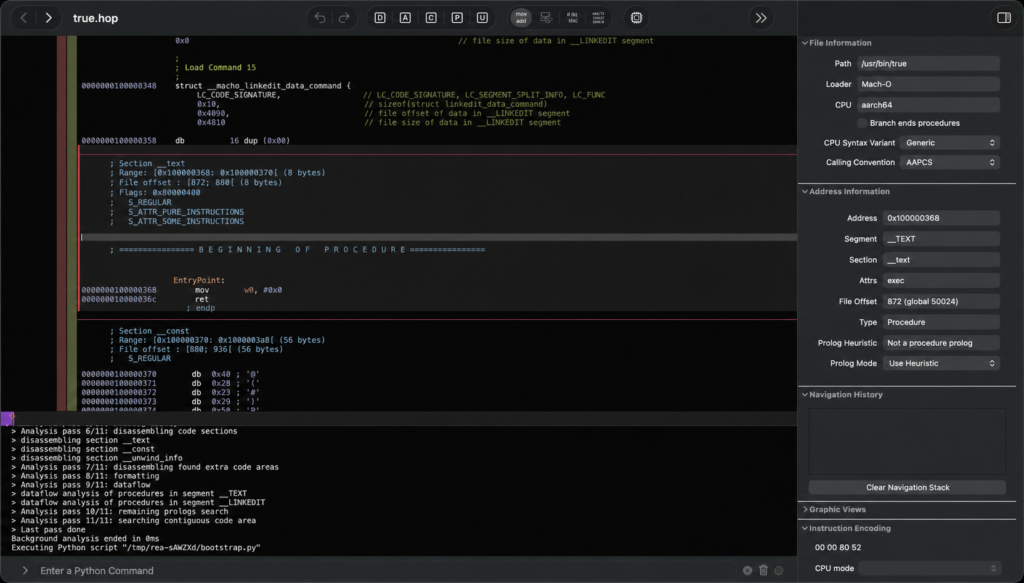
An open-source toolkit called REA wants AI agents to do the work reverse engineers do by hand: open an application without source code, explain how a feature works down to the native binary, and show the evidence. Released on GitHub in April 2026, the project reached 2,862 stars and 301 forks in six months, with the rea-agents npm package at version 2.5.0.
What the toolkit covers
REA standardizes how agents investigate software. Deep native analysis runs through Hopper on macOS or a bring-your-own Ghidra provider on Linux, with an experimental Windows x64 Ghidra path for approved native PE targets. The Ghidra adapter is read-only by design: inventory, function metadata, decompilation, assembly, resolved calls, typed references, xrefs, control-flow graphs and function dossiers — 19 admitted operations, no GUI state, no mutations. Around that core sit execution-free managed PE triage, controlled process capture, passive website and Electron page observation through the V8 Inspector, bounded JavaScript reconstruction with source maps, and provider-neutral graphs that connect application layers without conflating static inference with runtime observation.
Why local-by-design matters
The analysis boundary is the security-relevant decision: everything runs on the local host, and REA never uploads the target application to a hosted analysis service. For cloud teams, that maps to the same data-flow discipline already applied to LLM tooling — the binary under investigation may be proprietary malware or a third-party artifact you are contractually bound to contain. Only the context slices the agent chooses leave the machine, which keeps the exposure surface explicit and auditable. The same principle drives guidance on prompt injection defenses in cloud LLM applications: know exactly what crosses the boundary.
The defensive use case
Where REA changes economics is incident response. Triaging an unknown binary — a suspicious installer in an asar archive, a vendor DLL with odd behavior — is exactly the serial, tool-shuffling work agents absorb well. Reproducible Evidence v2 records mean a second analyst or a downstream SIEM case can verify each conclusion instead of trusting a summary. That fits the verification-first posture teams already apply to container image supply chains and to misconfiguration drift investigation: evidence you can replay beats output you must trust.
The other side of the tool
The capability cuts both ways. The same agent workflow that documents a proprietary protocol can be pointed at protected functionality to replicate it. REA ships under the MIT license with no use restrictions, and the responsibility stays with the operator. Security teams should read it as a preview of what is coming at scale: when reverse engineering becomes a conversational task, both defenders and IP thieves get the speedup. The parallel with offensive agent tooling is direct — the field that produced autonomous pentesting now has agent access to binary-level analysis as well.
Adoption notes
Requirements: Node.js 22.19+ or 24.11+, macOS 12+, Ubuntu 24.04+, Fedora 41+ or Arch Linux 64-bit. Setup is a single npx rea-agents setup command that detects installed agents — Claude Code, Claude Desktop, Codex, Cursor, Gemini CLI, Windsurf, Devin — and registers the MCP server plus routing skill, additive and backup-first. For teams, the relevant control points are the setup wizard’s explicit approval flow, the rea doctor environment diagnostic, and the decision of which binaries an agent is allowed to open in the first place.